Charles Darwin’s Notebooks: Ideas in Motion
Explore Charles Darwin’s notebooks for reading, observations, working ideas, and a compact life record—then design a journal system for one long inquiry.
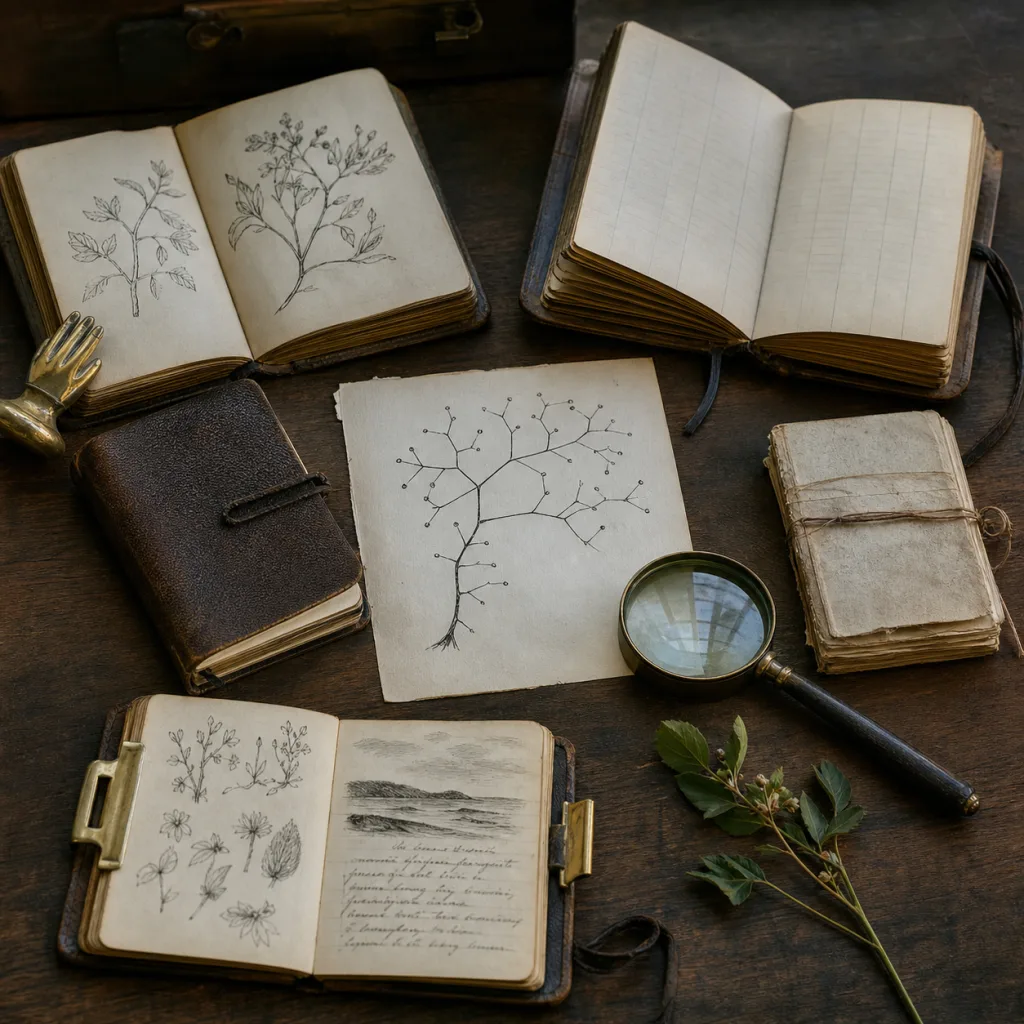
Charles Darwin did not rely on one all-purpose journal. He used different notebooks for reading, scientific questions, field observations, and a compact personal record. Together they show a useful principle: when a long inquiry grows complicated, separate records by the kind of thinking they need to preserve.
Different books carried different jobs
The Darwin Correspondence Project records that Darwin began listing books he had read and wanted to read in Notebook C in April 1838. Other notebooks followed developing questions about species. One small notebook begun in August 1838 became his personal “Journal,” with backdated events from his birth and later entries about work and private life.
The personal journal was unusually compressed. According to the scholarly introduction at Darwin Online, a year could occupy a page or less. From 1846, facing pages divided work from personal and family matters. This was a different object from a field notebook full of immediate observations or a reading notebook following sources.
The distinction helps explain why organizing multiple journals can be useful. Separate books are not automatically clutter. They become clutter when their jobs are indistinguishable.
A notebook can hold an idea before it becomes a theory
One of Darwin's surviving 1837 notebooks contains the branching “Tree of Life” sketch. Cambridge University Library describes it as an iconic page, but its importance is not that a finished theory appeared in one stroke. The notebook preserves an early form of a question that continued to develop through reading, evidence, comparison, and revision.
A private working page gives a difficult idea room to be provisional. It can hold a diagram, a contradiction, or a conjecture without presenting it as a conclusion. A research journal for a long project should preserve that distinction explicitly: source, observation, inference, and unresolved question.
Reading lists become more useful when they retain purpose
A list of books read can show coverage. A list of books to read can protect a future path. Neither explains why a title entered the inquiry. Add a short reason beside each source:
- the question it may answer;
- the claim it may challenge;
- the method or evidence it may provide;
- the earlier source that led you there;
- the reason you decided not to pursue it.
The final item matters. A recorded decision not to read something now can prevent the same uncertain detour from returning every week. Recording why a source entered or left the inquiry also makes it easier to find the old journal entry when the same question returns later.
Design a small notebook ecology
You do not need to reproduce Darwin's archive. For one sustained project, three sections may be enough:
- Observations: what you directly saw, measured, heard, or tried.
- Sources: what another person or text states, with a stable citation.
- Working ideas: the explanations, diagrams, and questions you are testing.
Keep a fourth personal timeline only if dates and life context matter to the project. A five-line monthly entry can preserve where you were, what occupied the work, and what changed. The goal is retrievability, not an impressive number of notebooks.
Keep the route, not only the answer
Published work hides many branches that led nowhere. A research notebook can retain them without shame. Record why a promising explanation failed, which observation forced a revision, and what you now need to compare. This is the path future you is least likely to reconstruct from the finished result.
If the project is also teaching you a skill, connect it to a learning journal that records attempts and mistakes. Start a private project journal on Inpages.me with one observation, one source, and one question that are not yet ready to become a conclusion.
Sources and notes
- Darwin Correspondence Project: Darwin's reading notebooks
- Darwin Online: introduction to Darwin's personal Journal
- University of Cambridge: Darwin's returned notebooks
Sources reviewed August 8, 2026. The article separates documented notebook practices from modern adaptations.
Your first quiet page
Keep writing, without turning your life into content.
Inpages.me is a calm digital journal for thoughts, photographs, and details you want to return to—without an audience or an endless feed.
Choose and pay for a membership before writing your first entry.