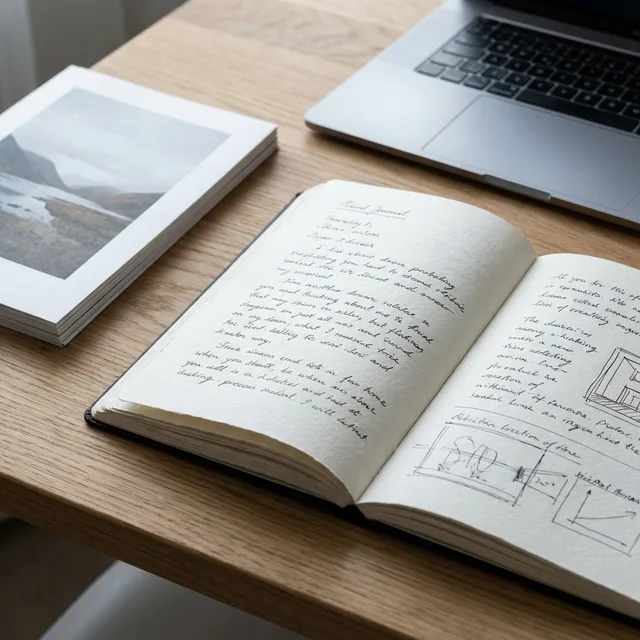
Hobby Journal Ideas for Making, Collecting, and Exploring
Find hobby journal ideas for making, collecting, and exploring, with repeatable entries that preserve projects, discoveries, sources, and small pleasures.

A hobby journal protects the part of a hobby that can disappear between finished projects, full shelves, and the next interesting thing: where your interest began, what you noticed, what you tried, and why one small object or practice mattered to you.
Choose a hobby-sized boundary
“Everything I enjoy” is too broad to return to. Begin with one making practice, collection, subject, season, or question: repairing old cameras, baking bread, birdwatching near home, learning watercolor, collecting postcards, or exploring neighborhood architecture.
If the hobby is teaching you a skill, let this journal connect to your broader learning journal without forcing both books to do the same work.
Make a first page that names the attraction
Write how you found the hobby, what draws you back, what you already have, and what you hope to notice. Add one photograph of the current state: the worktable, first shelf, sketchbook, field bag, or a single object. This is a beginning, not an inventory you must keep perfect.
Use one repeatable hobby entry
Date and place
What I made, found, watched, read, or tried
One detail worth keeping
Source, maker, or context when known
What I want to explore next
A repeatable shape makes the journal usable whether the hobby happens weekly or only when time opens up.
Record process, not only outcomes
Photograph the first attempt, the materials, the failed version, and the small adjustment that helped. For a hobby that becomes a longer piece of work, use a creative project journal to follow experiments and decisions in more depth.
Give collected things their stories
A collection becomes more personal when each item carries context: where it came from, who made it, how you acquired it, what you noticed first, and what it connects to. The Smithsonian notes that a single collection object can yield multiple stories when examined from different viewpoints in its lesson on collecting natural history. Use that principle gently: document what you know, and leave uncertainty visible.
Keep sources and credits close
When an idea comes from a teacher, maker, shop, archive, video, book, or community, note it. Link or photograph only where you have permission, and do not present someone else’s work as your own. A source line makes later revisiting more generous and more useful.
Pair photographs with captions
Caption an image with date, subject, place, and why you kept it. The guide to writing photo captions for your future self can help when a picture shows the object but not the reason it mattered. For building pages that hold both, use photos and text in one journal.
Let gaps belong to the record
Hobbies often pause for months. Do not fill the gap with an apology. When you return, write what changed: time, attention, tools, money, taste, energy, or curiosity. A journal can show a changing relationship to the hobby, not just steady output.
Begin with what is already near you
Choose one object, work-in-progress, or recent outing. Describe it before looking up more information. Then add the next small question. Start a private hobby journal on Inpages.me.
Your first quiet page
Keep writing, without turning your life into content.
Inpages.me is a calm digital journal for thoughts, photographs, and details you want to return to—without an audience or an endless feed.
Choose and pay for a membership before writing your first entry.