How to write a personal philosophy from your journal
Write a personal philosophy from things you have lived and learned. Use a simple template to turn journal reflections into beliefs you can revisit and revise.

A personal philosophy can begin as a few sentences about what you believe and how you want to live. Start with experiences you can name, write the understanding you took from them, and ask how that understanding affects an ordinary choice.
You can write the first version on one page. It does not need to explain every part of your life.
If you already keep a journal, you have somewhere to begin. The entry about a conversation, the account of a difficult week, and the note about an unexpectedly good afternoon may contain ideas you still agree with months later.
The task is to decide which of those ideas you want to carry forward.
Decide what this page is for
Choose one situation in which you want to be able to consult your philosophy. Perhaps you keep accepting work you do not have room for. Perhaps you want to remember what makes a friendship feel worth tending. Perhaps your life is changing and you want to name what still matters.
Write a short opening:
I am writing this so that, when I have too many possible commitments, I can remember what deserves my attention.
This gives your first page a purpose. You can add other parts of life later.
A philosophy journal gives you space to explore questions and arguments over time. A personal philosophy is the shorter set of statements you choose to keep within reach of those longer conversations.
Begin with a scene you remember
Choose a journal entry with a concrete event in it. Look for a choice you were glad you made, a cost you had not expected, or an ordinary moment you would like more of.
Consider this invented example:
I agreed to finish the presentation over the weekend. I delivered it, but I spent most of Saturday thinking about the promised afternoon with my sister.
The event does not prove a rule about all work or all weekends. It gives the writer a question: what did that choice reveal about the promises they want to protect?
A possible belief is:
A promise to someone close to me deserves a place in my plans before my week fills up.
Someone else might take a different lesson from the same event. Write the one you can explain from your own experience.
For a more detailed way to work through several entries, use the guide to turning journal entries into personal principles.
Give each sentence one idea
Try writing one belief at a time. If a sentence includes work, health, friendship, ambition, and the meaning of success, separate it into smaller claims.
“I want to live well” leaves a lot to interpret. “I want the people close to me to have more than the time left over after work” tells you something about a future decision.
You can use either a statement of understanding or a principle for action. For example:
- “I do more thoughtful work when I have some time without interruption.”
- “Before accepting another regular commitment, I will look at what it would displace.”
If the terms feel tangled, the guide to beliefs, values, and principles shows how they relate without requiring you to label every sentence.
Check what you would actually stand behind
Read each draft and ask:
- Can I name an experience that helps explain this?
- Does the sentence say more than that experience supports?
- Would it help me consider a real choice?
- Where might it need an exception?
“I should never change my plans” is difficult to defend when someone needs help or circumstances change. “I want to change a commitment deliberately, rather than let it disappear under newer requests” leaves room for those circumstances.
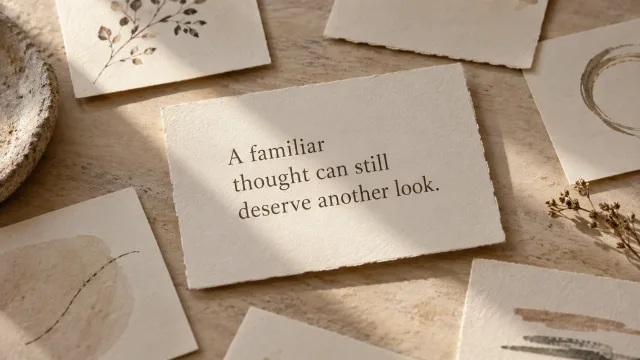
A familiar sentence can also deserve scrutiny. You may have repeated it for years because it sounded reasonable. Repetition tells you that a thought has stayed with you; it does not settle whether you still agree with it.
Put a first version on one page
Use this template in a notebook or a new journal entry:
What I want this page to help with:
The situations in which I want to return to it.What I currently believe:
Three to five separate sentences.What helped me arrive here:
A few experiences or links to entries.What remains open:
An exception, tension, or question I have not resolved.One choice I want to consider differently:
A situation already in front of me.
Three to five sentences is a manageable starting point for this exercise. You can keep fewer. You do not need to complete a set.
For example, a first page about attention might include:
I want room in my week for relationships that do not come with deadlines.
I do work I respect when I can give it sustained attention.
I can leave some possibilities unexplored so that a few commitments receive enough care.
These are example sentences, not a recommended philosophy for everyone. If a line feels borrowed, explain what you mean by it or leave it out. The personal beliefs examples offer other starting points.
Bring it to a real decision
The next time you face the situation you named, read the relevant sentence. Ask what it helps you notice and what else the decision requires.
The writer protecting time with a sibling might look at an invitation and ask, “What would I have to move to make this possible?” The belief introduces a consideration. It does not make the decision for them.
Afterward, write a few lines about what happened. You may find that the sentence needs clearer wording, that it fit this situation, or that another consideration mattered more.
You can add a later reflection to an existing journal entry when the original scene deserves that extra context.
Keep the short sentences near the longer story
You can keep the whole page in your journal. You can also keep the individual beliefs somewhere easier to revisit while leaving their reasons in the entries where they began.
Inpages.me's Beliefs feature lets you save short statements and optionally link your memories or diary entries. You choose the words and the connections.
See how to keep these sentences in Beliefs, or start by writing one sentence in the notebook you already use.
Continue reading
Keep the sentences you want to return to.
Beliefs gives each short statement a card, with room to link the writing behind it.