Mary Shelley’s Travel Journal
Explore Mary Shelley’s travel journal—routes, reading, grief, and the making of Frankenstein—and try a travel-work spread for one day on the move today.
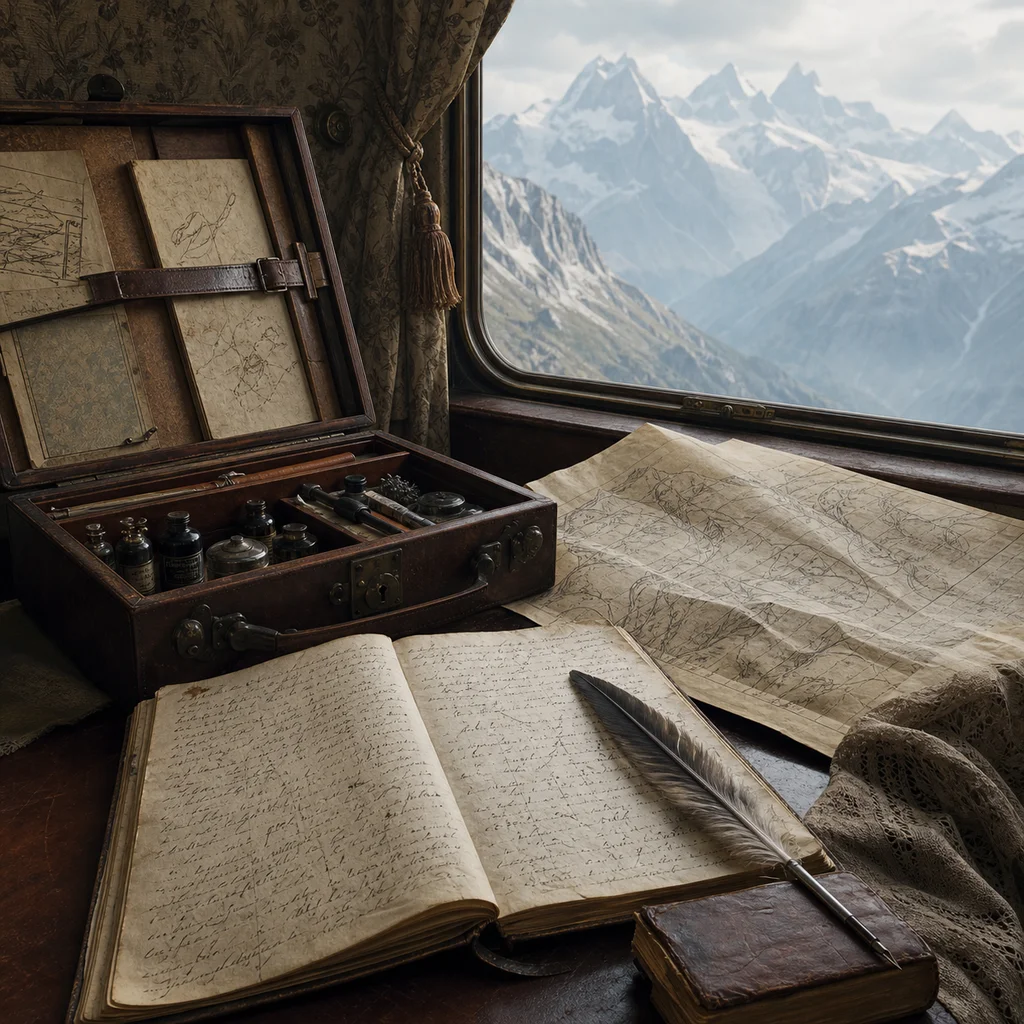
Mary Shelley kept a journal shared with Percy Bysshe Shelley from 1814 onward, recording travel, reading, conversations, births and deaths, financial strain, and the slow composition of Frankenstein. The Bodleian Libraries and scholarly editions preserve a notebook practice rooted in movement: Switzerland, Italy, England, and the daily life that surrounded literary work rather than replacing it.
Travel changed what the journal could hold
The Shelleys' journal notes routes, lodgings, weather, visitors, and the books they read aloud. Entry length follows circumstance: a day of carriage travel may receive a few lines; a period of settled writing may expand. The notebook keeps public and private worlds on the same page—letter writing, child care, grief, and drafts of poems or prose.
That mixture makes the journal a travel record and a working diary at once. Our guide to How to Keep a Travel Journal offers a modern structure; Mary Shelley's notebooks show how travel, reading, and creation can share one dated line when life will not stay still.
Shared authorship complicates the page
Scholars treat the journal as a collaborative document: Percy sometimes wrote entries, revised Mary's wording, or continued a day's record. A reader is never simply inside one private voice. That fact is useful. Many journals are technically solo while still carrying conversations, borrowed phrases, and the influence of people beside the writer.
When you journal with a partner, friend, or collaborator, note who wrote which entry if clarity matters later. Thomas Edison's laboratory notebooks solved a different problem—experiments shared across a lab—but both archives show that authorship and date are part of meaning.
Grief and creation occupied the same book
The journal records the deaths of children and friends, financial anxiety, and the continuing work of writing. It does not separate sorrow into a different volume from literary ambition. A modern reader should not treat that endurance as a lesson to copy under pressure. It is evidence of how one writer kept a record while life changed catastrophically.
If you are moving through a major transition, Journaling Through Life Changes offers ways to keep stages distinct without forcing resolution. John Quincy Adams's lifelong diary shows another archive in which public duty and private loss share decades of pages.
Try a travel-work spread
- Where: city, route, or room in one line.
- Movement: how the day changed your place.
- Reading or conversation: what entered your mind from outside.
- Work: one sentence about the project, even if no progress occurred.
- Carry: what unresolved question travels with you tomorrow.
Begin a private travel journal on Inpages.me with today's place, one line of reading or talk, and one note about the work still open beside you.
Sources and notes
- Bodleian Libraries: Shelley collections
- The Journals of Mary Shelley (Johns Hopkins edition overview)
Sources reviewed August 17, 2026. The article follows scholarly descriptions of shared authorship and avoids extended quotation from the journals.
Your first quiet page
Keep writing, without turning your life into content.
Inpages.me is a calm digital journal for thoughts, photographs, and details you want to return to—without an audience or an endless feed.
Choose and pay for a membership before writing your first entry.