Thomas Edison’s Laboratory Notebooks
Explore Thomas Edison’s laboratory notebook system, why permanent records replaced loose notes, and how to document experiments without polishing away failure.
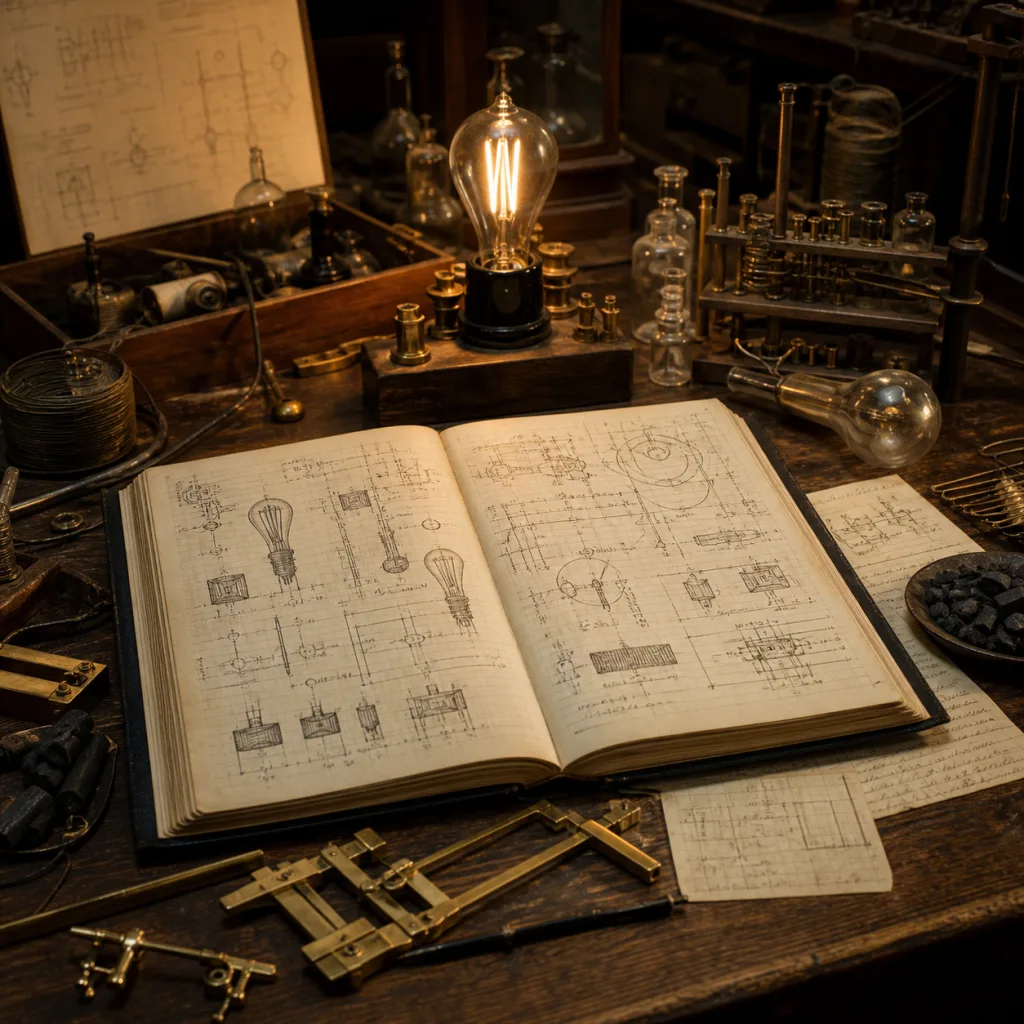
Thomas Edison's laboratory notebooks were working records shared across an inventive organization, not simply a famous man's private journal. In 1877 Edison made note-keeping more regular; by late 1878, expanding work on electric light led the laboratory to use standard hardbound notebooks that remained intact as permanent records.
The system changed when loose notes became too hard to manage
The Rutgers Edison Papers describes an earlier mixture of ledger volumes, pocket notebooks, tablets, and loose scraps. Notes from softcover tablets were often separated and reorganized around particular inventions. As the volume of drawings and experimental notes grew, Edison adopted standard six-by-nine-inch hardbound books.
The Thomas Edison National Historical Park archive holds more than three thousand of these notebooks, each around 280 pages. The scale is extraordinary, but the design change is ordinary: the existing capture system no longer preserved enough context, so the laboratory changed the container.
A laboratory notebook belonged to the work
Notebooks were placed around the laboratory and could record the work of more than one experimenter. That makes authorship and dates essential. A line or drawing detached from who made it, under what conditions, and after which attempt can become difficult to interpret.
A modern project journal should therefore distinguish:
- who performed the attempt;
- the date and project;
- materials, settings, or starting assumptions;
- what was directly observed;
- what interpretation or next test followed.
This structure is closer to a research journal for a long project than a personal diary. The distinction prevents a historical lab practice from becoming another vague “genius habit.”
Permanent does not mean polished
A permanent record keeps attempts in sequence. It does not require every page to look final. Crossed-out ideas, failed tests, changes in apparatus, and contributions from different people can be more useful than a clean retrospective summary.
When you correct an earlier entry, add a dated note. Do not silently replace the condition, observation, or reasoning. The value of the notebook lies partly in reconstructing what was known at that point.
Use one spread per experiment
For a creative or technical project, try this compact entry:
- Question: what are we trying to learn?
- Setup: what did we use or change?
- Observation: what happened, without explanation?
- Interpretation: what might account for it?
- Next attempt: what will be held constant or changed?
Attach files and images with stable names. Record links rather than assuming a chat thread or temporary folder will remain available. Our guide to journaling a creative project can carry the decisions and emotions around the work while this format holds experimental detail.
Build an archive only as complex as the project
Three thousand notebooks are the residue of a large laboratory over many years, not a starting recommendation. A solo project may need one dated journal, a light index, and clear links to source files. Add structure only after retrieval fails in a specific way. If one book starts carrying unrelated experiments, decisions, and personal reflection, use the same job-based test described in How to Organize Multiple Journals before creating another container.
Create a journal index that can last when entries begin crossing projects. Preserve the route from question to attempt before optimizing the archive around a scale you do not yet have.
Begin a private project record on Inpages.me with the next experiment and the context your future self would otherwise have to guess.
Sources and notes
Sources reviewed August 8, 2026. The article treats the notebooks as collaborative laboratory records and does not attribute every surviving entry to Edison personally.
Your first quiet page
Keep writing, without turning your life into content.
Inpages.me is a calm digital journal for thoughts, photographs, and details you want to return to—without an audience or an endless feed.
Choose and pay for a membership before writing your first entry.