Why Anne Frank Rewrote Her Diary
Learn why Anne Frank rewrote her diary for a future book, how her two versions differ, and why her authorship must remain within its Holocaust context.
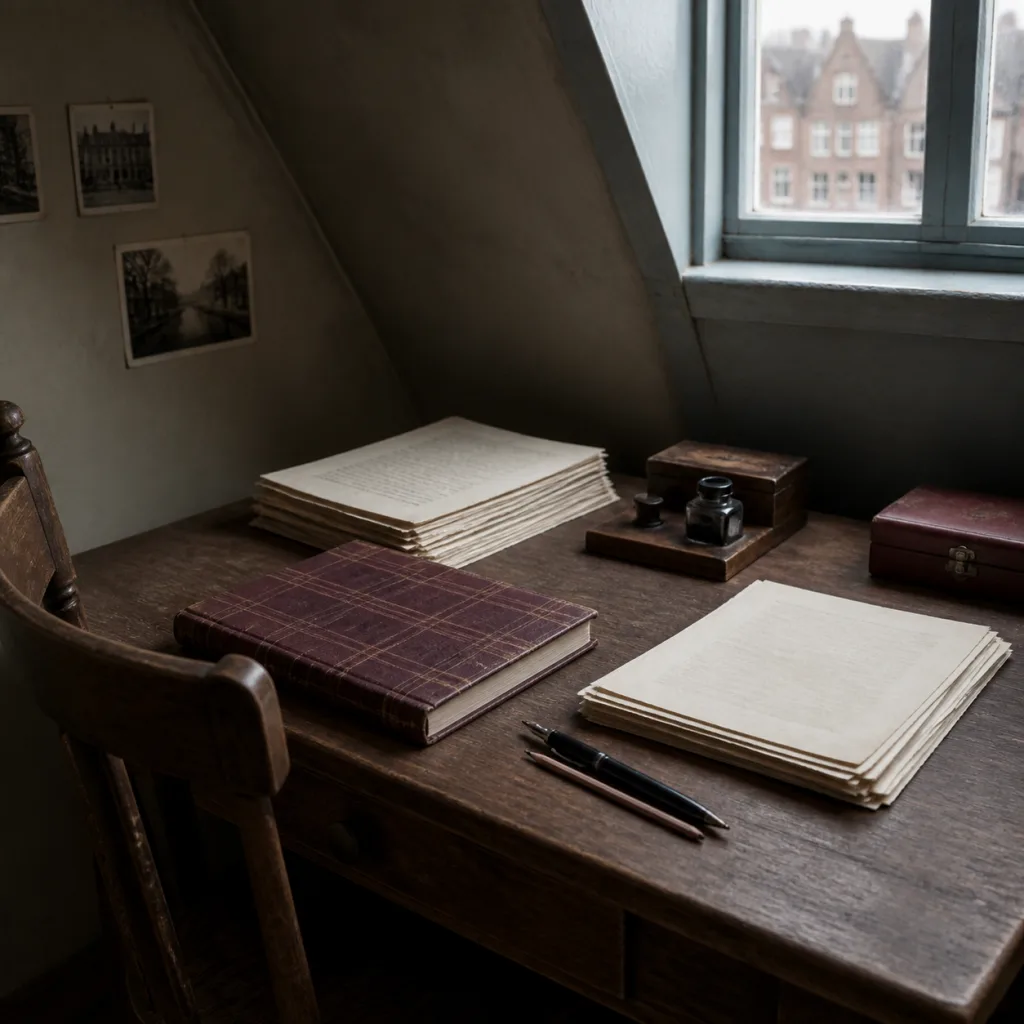
Anne Frank kept an original diary while hiding from Nazi persecution, then began rewriting much of it in May 1944 for a book she hoped to publish after the war. The two versions show a young writer making deliberate editorial choices. They must be understood within the history of the Holocaust, not reduced to a general lesson about productivity or personal branding.
The original diary and rewritten version served different purposes
Anne began her diary in June 1942, shortly before her family entered hiding in the Secret Annex in Amsterdam. The surviving original notebooks and later loose sheets document daily life, fear, conflict, hope, study, and her development as a writer under persecution.
After hearing a March 1944 radio appeal asking people to preserve wartime diaries and letters, Anne decided to reshape her material into a book. On May 20 she began rewriting earlier entries on loose sheets. She chose the title Het Achterhuis, or The Secret Annex.
Rewriting meant selecting, combining, and changing emphasis
The Anne Frank House documents substantial differences between the original version, commonly called Version A, and Anne's rewritten Version B. She shortened some sections, reorganized material, combined entries from different dates, and omitted passages that no longer matched what she wanted the book to carry.
These were not corrections made by someone who had forgotten the original experience decades later. They were editorial decisions by Anne herself while still in hiding. The two versions let readers see both immediate writing and an emerging literary work.
This distinction is central to the difference between a journal and a memoir. A journal records close to lived time. A work prepared for readers selects and arranges that record. Neither form makes the other unnecessary.
The diary was part of a larger writing practice
Anne also wrote stories and kept a notebook of favorite sentences. The Anne Frank House records forty stories in her story collection, many focused on life in hiding and others invented. This matters because public memory can flatten her into a person who happened to leave a diary. The documents also show a serious young writer practicing different forms.
Reading the diary should preserve Anne's authorship as well as the historical circumstances that confined and ultimately killed her. Her writing is evidence of one particular life and voice, not a symbol that can safely stand in for every Holocaust experience.
Keep private writing separate from a public draft
For a modern writer developing personal material, use two documents:
- The private record: the dated page written without a public audience.
- The reader draft: a separately copied version shaped with consent, context, and consequences in mind.
Do not overwrite the private page while preparing the public one. The differences may later help you understand how time, audience, safety, and purpose changed the story. Keeping the two documents separate also preserves the boundary between a private journal and a public blog. Before sharing, use the questions in Share Journal Entries Without Oversharing to protect living people and details that were never yours alone.
Publication requires historical and ethical context
Anne was arrested before she could finish the book. After the war, her father Otto Frank worked from the surviving materials toward publication. Any account of the diary's later form must therefore identify which version is being discussed and whose editorial decisions followed Anne's own work.
A personal archive is never only raw material. It holds relationships, unequal risks, and a writer's changing intentions. Preserving it carefully begins with naming those boundaries rather than assuming that a meaningful page is automatically meant for everyone.
Sources and further reading
- Anne Frank House: the two versions of Anne's diary
- Anne Frank House research: Anne rewrites her diary
- Anne Frank House: Anne's stories and writing
Sources reviewed August 8, 2026. This article relies on the Anne Frank House and avoids extended quotation from the diary.
Your first quiet page
Keep writing, without turning your life into content.
Inpages.me is a calm digital journal for thoughts, photographs, and details you want to return to—without an audience or an endless feed.
Choose and pay for a membership before writing your first entry.