Dorothy Wordsworth’s Grasmere Journal
Explore Dorothy Wordsworth’s Grasmere Journal—walks, weather, and ordinary days written for private pleasure—and try a simple scene note from one walk.
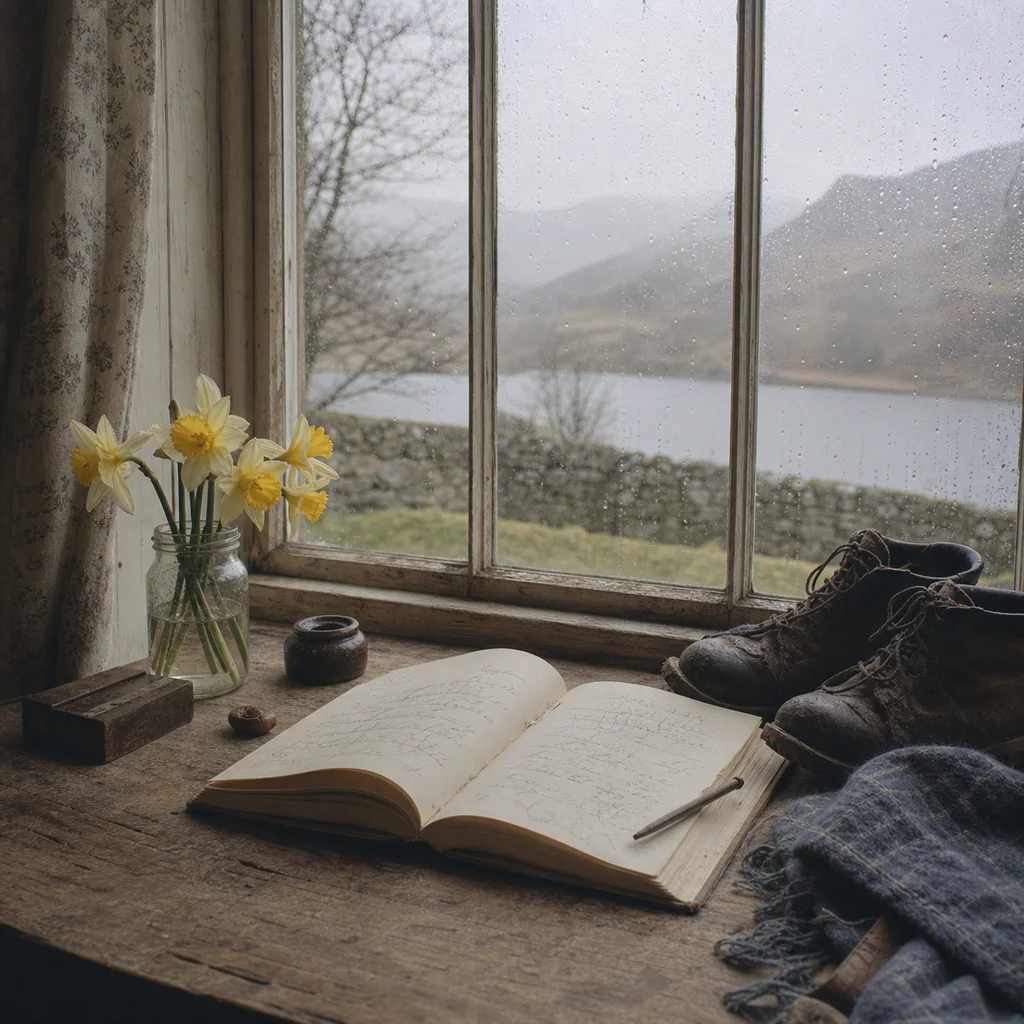
Dorothy Wordsworth kept the Grasmere Journal at Dove Cottage from May 1800 to 1803. She wrote for her brother William, not for publication, recording walks, weather, neighbours, garden work, and the ordinary life from which some of his poems grew. The Oxford edition edited by Pamela Woof preserves both the Grasmere and earlier Alfoxden journals as a model of attentive daily writing.
The journal was written for one reader
Dorothy told William she hoped the notebook would "give Wm Pleasure by it." That private audience shaped what she preserved: daffodils beside Ullswater, a beggar on the road, children at play, the labour of keeping a household, and the moods of the Lake District sky. The journal was not a draft of finished poems. It was a shared field of attention.
William later said Dorothy "gave me eyes, she gave me ears." Whether or not every entry directly produced a poem, the notebooks show how closely observed ordinary days can become material for art without being written as art. Henry David Thoreau's journals pursued a different solitude, but both writers trusted recurrence: the same walk, the same season, seen again.
Ordinary detail carried the record
Dorothy's entries move quickly through time, place, and weather. She notes who walked with whom, what was planted, what failed, and what the lake looked like at a particular hour. The value lies in specificity before significance arrives.
A modern reader does not need a famous sibling to borrow the method. Choose one week and record three anchors each day: where you were, who shared the hour if anyone did, and one sensory detail you would forget by next month. Our guide to How to Write About Ordinary Days expands that scene structure; Dorothy's journal shows how lightly it can be held.
Do not turn a private gift into a performance
Because Dorothy's journal later entered literary history, it is easy to read every walk as prelude to a canonical poem. The manuscripts resist that simplification. Many pages simply keep company with a life: illness, errands, hospitality, and weather that never became a line of verse.
If you write for someone you love, name the boundary. Is the notebook a gift, a shared archive, or a page that may one day be read by others? John Quincy Adams's diary moved between self-improvement and historical record across decades; Dorothy's Grasmere years show how a short, intense period can still preserve a world.
Try a walk note without a lesson
- Route: name the path or room as plainly as possible.
- Companion: note who was there, or that you were alone.
- Weather and light: one sentence only.
- One seen thing: a plant, face, animal, or object.
- Stop: resist explaining why it mattered.
When you later reread old journal entries, compare entries from the same month across years. Dorothy's notebooks reward that kind of return: not because every day became important, but because the texture of ordinary life survived.
Begin a private daily journal on Inpages.me with one walk, one weather note, and one detail you would like your future self to recognize.
Sources and notes
- Oxford University Press: The Grasmere and Alfoxden Journals
- Internet Archive: The Grasmere and Alfoxden journals
Sources reviewed August 17, 2026. Short quotations follow the Oxford World's Classics edition edited by Pamela Woof.
Your first quiet page
Keep writing, without turning your life into content.
Inpages.me is a calm digital journal for thoughts, photographs, and details you want to return to—without an audience or an endless feed.
Choose and pay for a membership before writing your first entry.