Louisa May Alcott’s Writing Journals
Explore Louisa May Alcott’s writing journals—craft, money, family, and the making of Little Women—and try a four-line record after your next work session.
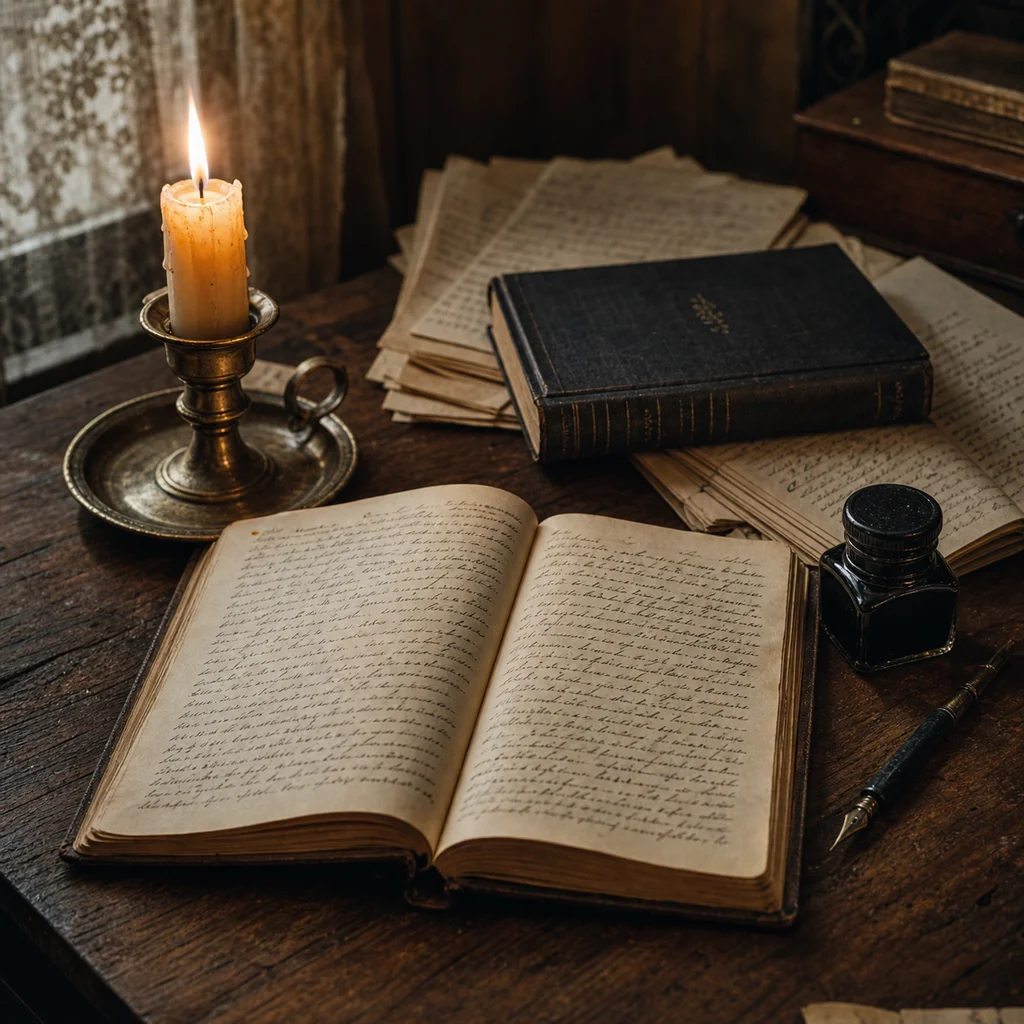
Louisa May Alcott kept journals from adolescence through her literary career, documenting family life, poverty, Civil War service, publication struggles, and the making of books such as Little Women. Harvard's Houghton Library holds much of the manuscript record. Her notebooks show a working writer's diary: part account book, part emotional record, and part ledger of plots still forming.
The journal followed the work, not the myth
Alcott's journals record what sustained and what drained her: writing for money, caring for her family, illness, travel, and the slow arrival of recognition. She noted word counts, payments, rejections, and revisions with the same directness she brought to private feeling. The notebook was where a professional life could be examined without performing success.
That makes her archive useful for anyone building a creative practice under real constraints. Virginia Woolf's reading notebooks tracked craft from another angle—books read with a pen in hand—while Alcott's journals keep the economic and domestic facts that surround making.
Private pages can hold ambition and doubt together
Alcott sometimes addressed her journal as a confidant, recording discouragement as plainly as triumph. The pages do not prove that journaling caused her career. They show how a writer returned to the same book to ask whether the work was worth continuing and what it cost.
A modern adaptation can be small. After a meaningful work session, write four lines:
- what you attempted;
- what surprised you;
- what the session cost in time or energy;
- what you will try next, if anything.
This overlaps with How to Journal a Creative Project, but Alcott's example adds the financial and family context that many craft guides omit. John Steinbeck's Journal of a Novel narrowed the same idea to one book; Alcott's notebooks span a lifetime of projects.
Do not copy the hardship as a requirement
Alcott's nineteenth-century circumstances—gendered expectations, household labour, and precarious income—shaped what she could write and when. Admiring her discipline does not require reproducing her conditions. The transferable lesson is continuity: return to the notebook with honest numbers and feelings rather than a polished public story.
Keep the private draft separate from the public book
Alcott revised life into fiction. The journals preserve the distance between lived event and published scene. If you also shape personal material for readers, keep the working diary distinct from the manuscript meant for others, as Anne Frank's two diary versions make visible at a different scale and history.
Begin a private writer's journal on Inpages.me with today's work session, one honest obstacle, and one sentence about what the project still needs.
Sources and notes
Sources reviewed August 17, 2026. The article paraphrases documented journal practices and avoids extended quotation from unpublished manuscripts.
Your first quiet page
Keep writing, without turning your life into content.
Inpages.me is a calm digital journal for thoughts, photographs, and details you want to return to—without an audience or an endless feed.
Choose and pay for a membership before writing your first entry.