Henry David Thoreau’s Journals: A Life of Listening
Explore Henry David Thoreau’s 47 journal volumes at the Morgan Library—observation, revision, and natural history—and try a simple practice of listening today.
Henry David Thoreau kept journal notebooks for nearly twenty-five years, from October 1837 until a few days before his death in 1862. The Morgan Library & Museum holds thirty-nine of the forty-seven manuscript volumes. The record is not a tidy daily diary. It became a working surface for observation, revision, natural history, and the sentences that later entered his lectures and books.
The journal grew into a writer's laboratory
Thoreau began the notebooks as a young man in Concord. Over time they absorbed weather, plant and animal sightings, walks, reading, and the first forms of ideas he would later test in public writing. Two volumes written while he lived near Walden Pond supplied material for Walden. The Morgan's catalog notes that many leaves were excised for lectures and essays, which means the surviving book is both a diary and a quarry.
That dual use matters. A page can hold a morning's detail and an evening's revision. What looks like repetition may be Thoreau listening again to the same place until language catches up. Charles Darwin's separate notebooks show a similar principle at scientific scale: different containers for observation, reading, and working thought.
Listening was the practice, not productivity
In 1852 Thoreau wrote that on some fortunate days he felt attuned to the universe—"fitted to hear." The Morgan's online exhibition on his journal treats that line as representative: the notebooks record an effort to pay close attention and return to what was noticed before it vanished into habit.
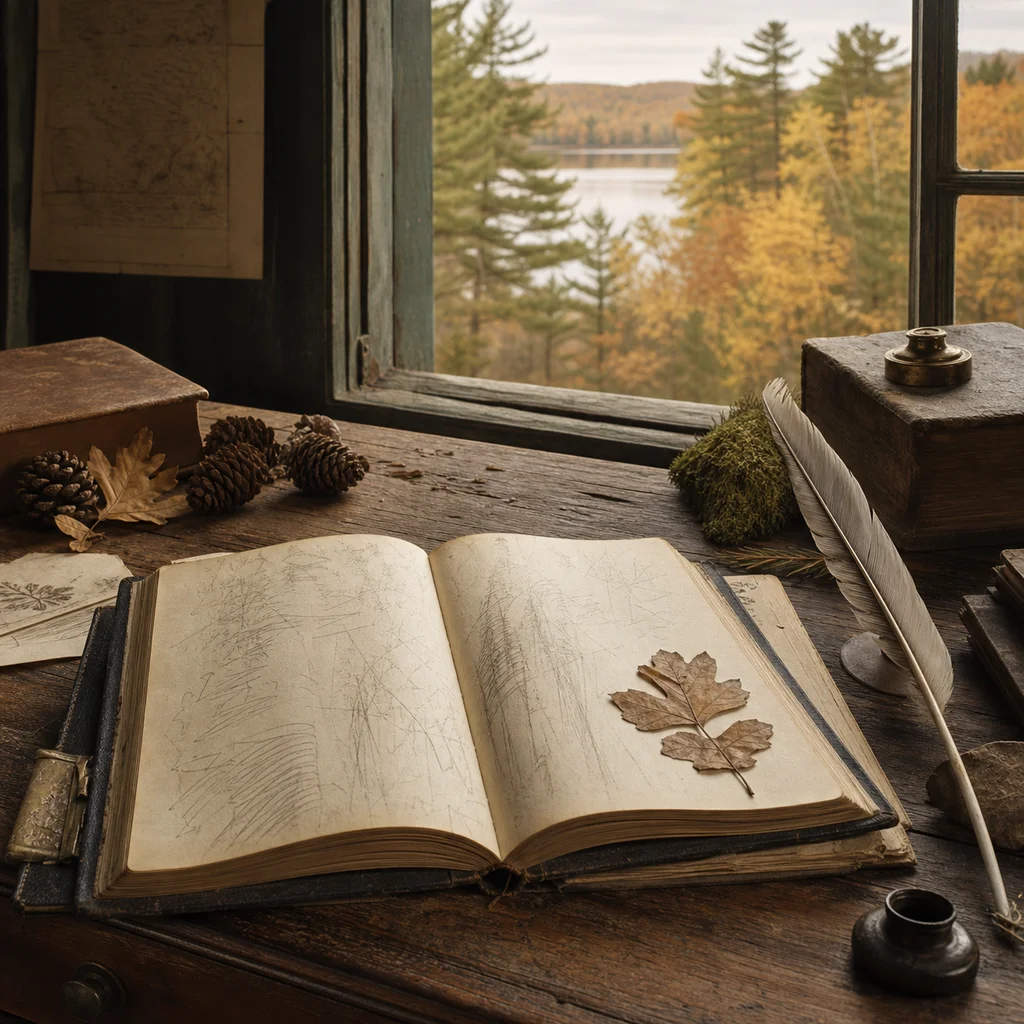
The journals include sketches of plants, fungi, and leaves, lists of sightings, and pressed specimens tucked between pages. The point was not to fill a quota. It was to keep perception alive long enough for thought to meet it. Leonardo da Vinci's notebooks worked the same border between seeing and explaining, though in a different century and craft.
Try one scene before you try to sound like Thoreau
Choose a walk you have taken often enough to stop noticing it. Before writing, stand still for one minute. Then record:
- Place: one concrete detail you could touch or hear.
- Change: what is different from last week, even slightly.
- Question: what you do not yet understand about what you saw.
- Return: a date to look again rather than resolve the question now.
This is close to the scene method in How to Write About Ordinary Days, but it keeps Thoreau's emphasis on recurrence. Dorothy Wordsworth's Grasmere Journal preserved ordinary walks and weather with a similar immediacy, written for a private reader rather than a public book.
A long journal can stay local
Thoreau's notebooks eventually filled thousands of pages, yet much of their force comes from one town, its ponds, woods, and seasons revisited until they disclose more. You do not need travel or exceptional events to begin. You need a place worth returning to with honest attention.
Begin a private observation journal on Inpages.me with one detail from today and one question you would like to ask the same place again next month.
Sources and notes
- The Morgan Library & Museum: Thoreau journal collection
- The Writings of Henry D. Thoreau: journals
- The Morgan: Thoreau’s Journal—A Life of Listening
Sources reviewed August 17, 2026. Volume counts follow the Morgan catalog and Princeton University Press edition notes.
Your first quiet page
Keep writing, without turning your life into content.
Inpages.me is a calm digital journal for thoughts, photographs, and details you want to return to—without an audience or an endless feed.
Choose and pay for a membership before writing your first entry.