How Leonardo da Vinci Used His Notebooks
Explore Leonardo da Vinci’s notebooks as working pages for drawings, observations, questions, and mechanisms—and try a simple visual thinking practice.
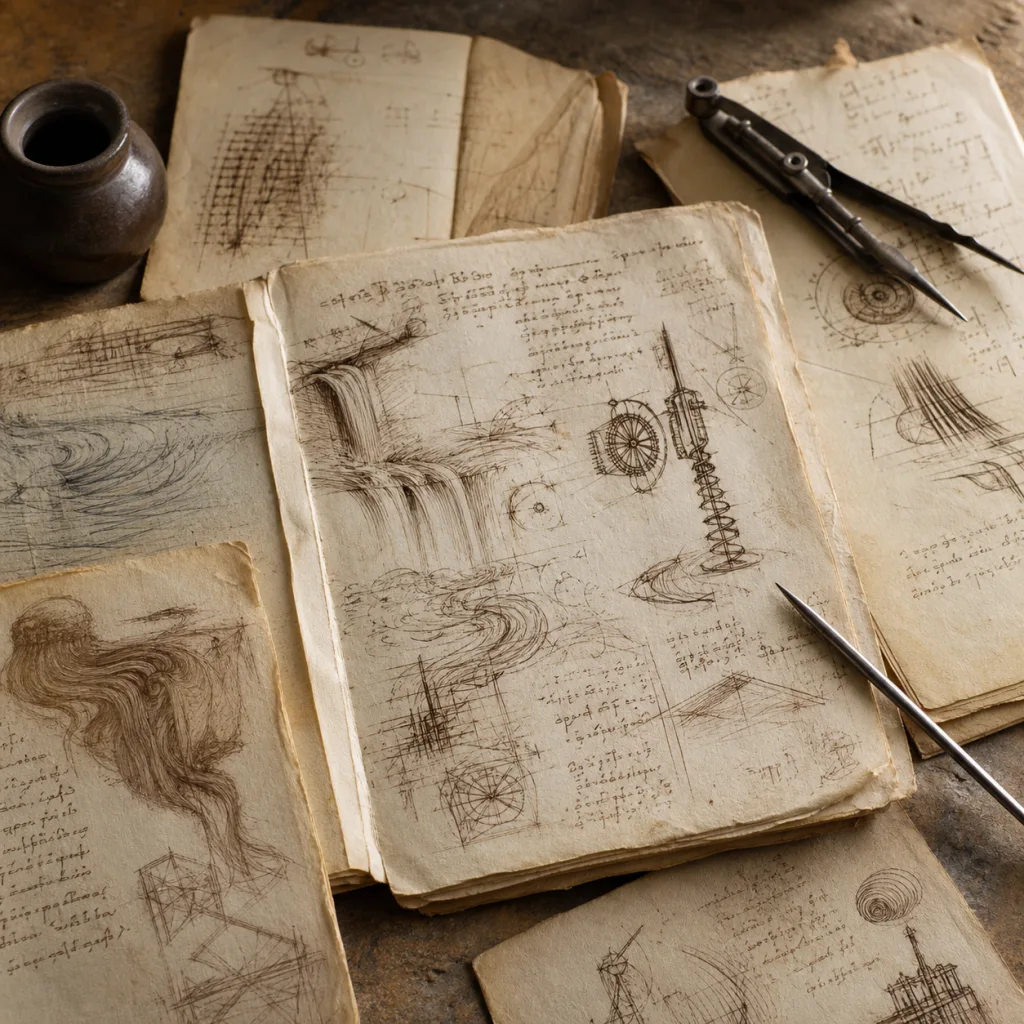
Leonardo da Vinci used notebooks as working surfaces where drawings, measurements, mechanisms, anatomical observations, questions, and ordinary notes could meet. The surviving pages do not reveal a tidy “genius system.” They show thinking in motion: visual and verbal, exact and speculative, sometimes gathered on loose sheets before later binding.
The page was a place to investigate
The Victoria and Albert Museum holds five of Leonardo's notebooks, now bound into three volumes called the Forster Codices. They date from roughly 1487 to 1505. Their subjects range across hydraulics, weights, geometry, anatomy, clothing, mechanisms, and the measurement of solid forms.
One page might develop a technical problem while another places a horse's leg near notes on weights or water. The group is not arranged as a modern textbook. According to the V&A, the notebooks were later bound without a logical order, and some writing crosses what became an inner margin—evidence that Leonardo may have written on loose sheets before they were folded.
This changes how we read the object. It was not necessarily a beautiful bound journal waiting to be filled from front to back. Paper first served the observation. The book we inherit is partly the result of later preservation.
Words and pictures carried different parts of the thought
Leonardo annotated careful diagrams and sketches with notes. A drawing could hold proportion, motion, or spatial relationships that prose would struggle to contain. Words could name a question, calculation, material, or next investigation that the image alone could not preserve.
The lesson is not that every journal needs accomplished art. It is that a thought does not always arrive as a paragraph. An arrow can show a force. A rough plan can expose a missing step. A diagram can hold several relationships at once. If you are recording a creative project from idea to finish, let the form of the entry follow the problem.
Mirror writing was not a proven secret code
Leonardo's right-to-left mirror writing has encouraged stories about secrecy. The V&A offers a more careful account: he was left-handed, writing masters of the period demonstrated mirror writing, and the script can be deciphered once a reader becomes familiar with it. Privacy may have been useful, but the surviving evidence does not justify treating every reversed line as encryption.
This distinction matters for modern journalers. A writing habit that slows a casual reader is not the same as protection designed around who holds a decryption key. If the page contains sensitive material, use the appropriate digital journal privacy checklist instead of relying on obscurity.
Try an observation page, not a Leonardo imitation
Choose one ordinary object or process you genuinely want to understand: a plant on your desk, the route of rainwater past your window, the hinge on a door, or the way a recurring task moves through your week.
- Draw its shape or sequence without trying to make the page impressive.
- Label what you can directly observe.
- Write three questions beside the drawing.
- Separate what you know from what you are guessing.
- Return after another observation and add a dated correction rather than erasing the first view.
The result may resemble a field note, a sketchbook page, or a modern commonplace entry. Its purpose is not to look like a Renaissance manuscript. It is to keep perception and explanation close enough to challenge each other.
A notebook can preserve unfinished intelligence
Leonardo's notebooks are compelling partly because they retain questions and attempts, not only finished works. We see the page before the conclusion became clean. That unfinished quality is useful in a private journal: it gives an idea somewhere to exist before it can defend itself. When the observation also supports a skill you are developing, a learning journal that preserves attempts and mistakes can keep the unfinished route visible.
Begin a private observation journal on Inpages.me with one thing you noticed today and one drawing, list, or question that helps you look again.
Sources and notes
Sources reviewed August 8, 2026. Manuscript-image reuse requires checking the V&A rights statement for the specific image.
Your first quiet page
Keep writing, without turning your life into content.
Inpages.me is a calm digital journal for thoughts, photographs, and details you want to return to—without an audience or an endless feed.
Choose and pay for a membership before writing your first entry.