Beatrix Potter’s Nature Journals
Explore Beatrix Potter’s nature journals—drawings, specimens, coded diaries, and precise observation before Peter Rabbit—and try one specimen page today.
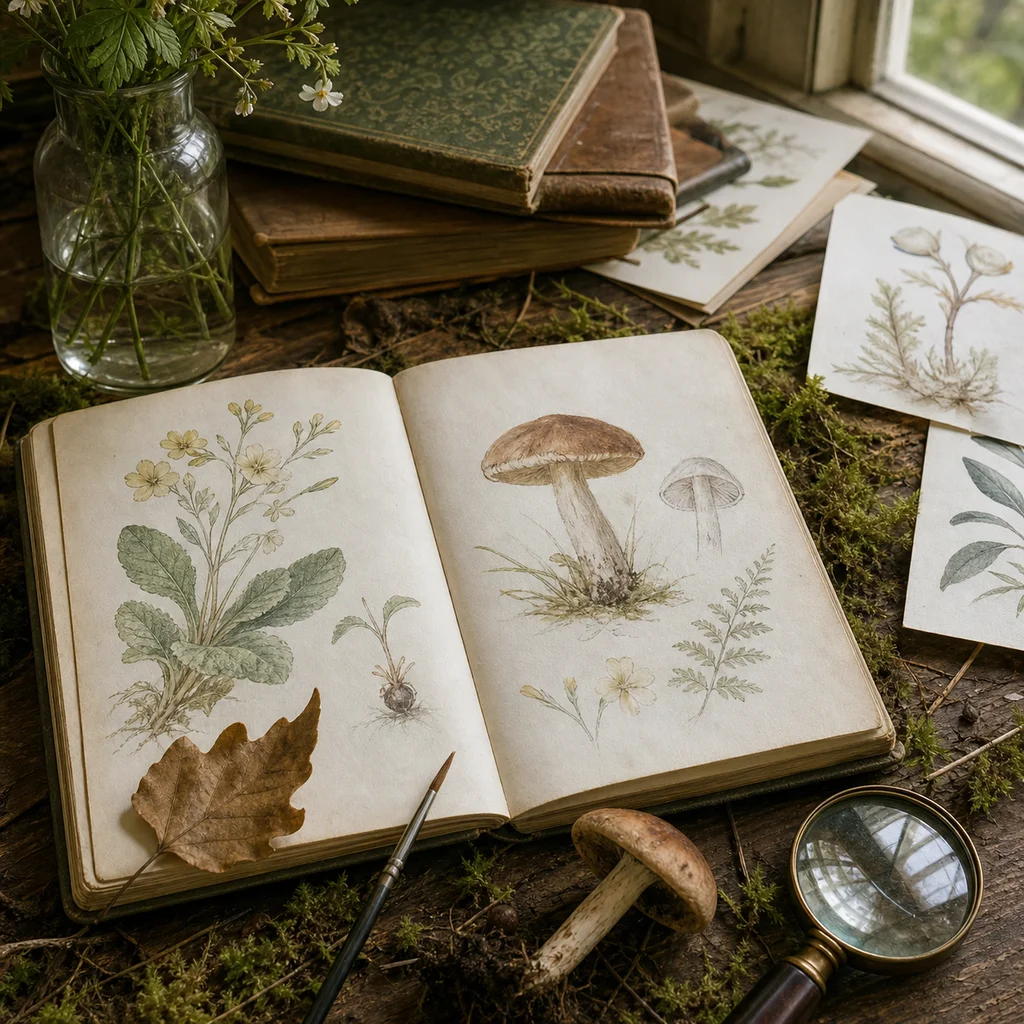
Before she became a beloved children's author, Beatrix Potter kept nature journals and coded diary volumes filled with observations, drawings, and experiments in precise looking. The Victoria and Albert Museum holds the world's largest collection of her manuscripts, including early sketchbooks and the journals later deciphered by Leslie Linder. The pages show how a private record of plants, animals, and places preceded published tales.
Observation came before story
Potter drew fungi, insects, fossils, and landscapes with the attention of a naturalist. She made notes about habitat, structure, and colour while still a teenager and young woman. Many studies were never meant for a book market. They trained her eye and hand long before Peter Rabbit appeared.
That sequence matters for anyone who thinks they need a finished style before keeping a journal. Leonardo da Vinci's notebooks mixed drawing and question on working pages; Potter's journals show the same patience applied to English gardens, farms, and the Lake District. Inside Frida Kahlo's Illustrated Diary worked later and more symbolically, but all three trusted the page to hold what language alone could not.
A coded diary is not the same as encryption
Potter wrote some journal volumes in a private code that remained unread until Linder deciphered them in the twentieth century. The code slowed casual readers; it did not create modern cryptographic protection. Treat it as obscurity chosen for privacy, comparable in category—though not in motive—to Samuel Pepys's shorthand.
If your journal contains sensitive material today, use the digital journal privacy checklist rather than inventing a personal cipher without a durable key.
Try a nature page with one specimen
- Draw or photograph one object closely—a leaf, shell, cup, or animal track.
- Label what you can verify without guessing.
- Note context: where it was, season, weather, time of day.
- Ask one question you could answer by looking again later.
- Return on a later date and add a correction rather than erasing the first page.
This is essentially a learning journal built from the visible world. Accuracy matters more than charm. Potter's published stories later borrowed the posture of accurate looking even when the characters became rabbits and mice.
Private study and public work can diverge
The V&A collection includes business records, corrected proofs, and preparatory drawings that never became books. A journal can hold decades of private study while public work selects only part of it. Do not assume every skilled page wants an audience.
Begin a private nature journal on Inpages.me with one drawing or photograph, three verified labels, and one question for your next walk.
Sources and notes
- Victoria and Albert Museum: Beatrix Potter collection
- V&A: How Leslie Linder deciphered Potter's journal
Sources reviewed August 17, 2026. The article does not reproduce Potter's coded text or copyrighted illustrations.
Your first quiet page
Keep writing, without turning your life into content.
Inpages.me is a calm digital journal for thoughts, photographs, and details you want to return to—without an audience or an endless feed.
Choose and pay for a membership before writing your first entry.