Where Can I Write a Private Diary Online?
Find where to write a private diary online by choosing a calm writing surface, checking the privacy boundary, and testing one ordinary page before you commit.

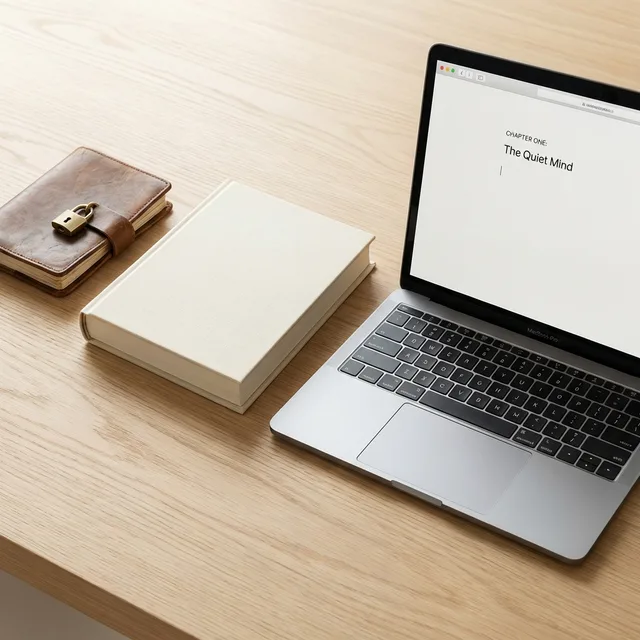
You can write a private diary online in more places than ever: a blank document, a notes app, a purpose-built journal, a self-hosted file, or a notebook that never touches the internet. The useful question is not which option has the longest feature list. It is which place will let you write honestly, understand the boundary around your page, and still feel possible to return to when the day is ordinary and your energy is low.
Start with the kind of privacy you are looking for
“Private” can mean that no one sees the page unless you choose to share it. It can mean that a diary stays out of public profiles and search engines. It can mean that someone borrowing your computer cannot casually open it. Or it can mean that selected writing is encrypted in your browser before the service stores it.
These are not interchangeable promises. A private visibility setting is important if you want no audience. A password and device lock matter on a shared screen. Client-side encryption matters if you want protected content to be unreadable to the service in ordinary operation. Before choosing where to write, name the worry you are trying to reduce. The private journaling app checklist can help you compare each boundary without relying on a lock icon alone.
Choose the surface that invites your real voice
A general notes app is useful when writing is likely to become a task, list, reference, or shared document. A paper notebook may be right when you want no screen at all. A dedicated digital journal earns its place when you want personal writing to have a different rhythm: dated pages, photographs beside their meaning, space for a longer thought, and a record you might reread years later.
Do not choose only by where you are most productive. Choose by where you are most likely to tell the longer version. If your notes app makes every thought feel like an item to sort, a private journal can become a useful change of room. Read digital journal versus notes app for a clear way to divide their jobs.
Let the device you actually use shape the choice
Some people need a phone-sized place for quick observations. Others only find the words when they sit at a laptop with both hands free. You may want a browser-based diary because it can meet you on the computer where long thoughts arrive, or a native mobile app because you write while moving through the day. Neither is more serious; the useful option is the one that removes the smallest amount of friction from your real habit.
Try the first page on the device you will use after a difficult day—not only on the device you have in your hand while choosing. Our guide to web journals and mobile apps can help you test that decision without pretending one form fits every life.
Look for a boundary you can explain back to yourself
A good diary should not require you to become a security specialist. It should make the important questions answerable. Can the service read an ordinary entry? Which fields and files are encrypted? What remains visible as metadata? What happens when you sign out, lose a password, change devices, export your archive, or deliberately share a page?
If the answer is only “military-grade,” “secure,” or “private by design,” keep looking. Honest products make their limitations readable too. An online diary with a lock can reduce casual access, but it is still worth knowing what the lock does not protect.
Test the place with a page that is safe to lose
Do not begin your trial with the hardest thing you have ever wanted to say. Write about a meal, a train ride, a sentence from a friend, or the weather outside your window. Then test the parts of the experience that decide whether you can rely on it: return after a sign-out, see whether the privacy state is clear, add a photograph if that matters to you, and learn what recovery or export means.
This is not a performance review for the diary. It is a rehearsal for trust. A small, ordinary page gives you the chance to discover whether the place feels calm enough for the larger stories later.
Keep public writing as a separate choice
A diary online does not need to become a diary for the internet. Write the personal version first. If you ever want to turn one page into a public story, treat that as a new act of editing: remove details that belong to other people, reconsider photographs and links, and understand what changes when a page becomes readable and indexable.
That separation protects the unfinished thought a diary is for. Our guide to sharing journal entries without oversharing can help when the time to make that decision comes.
Choose a place for the next page, not your entire life at once
You do not have to select the perfect forever archive before you begin writing. Choose a place that lets you take one honest step now, then learn from using it. The diary can prove its value gradually: through the first private relief of saying something plainly, the first ordinary detail you are glad you kept, and the first page you return to with more kindness than you expected.
Start a private journal on Inpages.me with one page from today. You are not committing to a finished version of yourself. You are simply giving the present a place to remain.
Your first quiet page
Choose a place that makes honesty easier to return to.
Inpages is a calm browser-based journal for personal writing that deserves more room than a public feed or a crowded notes inbox.
Choose and pay for a membership before writing your first entry.
Create your account, then test the space with one small memory from today.