Build a personal feelings list in your own words
Build a personal feelings list with 24 everyday words and phrases. Choose names that fit your experience, keep the list small, and change it as needs change.
A personal feelings list is a short collection of words or phrases you use to describe what you notice in yourself. Start with three to five that sound familiar. You can change them as you learn which words fit.
“Sad,” “happy,” and “angry” may be enough for some moments. For others, “lonely in a busy room” or “confident, but rushing” may be easier to recognise. There is room for your own wording, including a mixture that does not fit under one neat label.
Use these 24 phrases as starting points
The following phrases are examples, not a checklist or a test. Choose a few, change the wording, or write something else. The headings simply make the list easier to browse.
When there is some breathing room
- Calm, with room to think.
- Quietly proud.
- Hopeful about what is next.
- Lighter after saying it.
When energy is high
- Excited, and ready to start.
- Confident, but rushing.
- Full of ideas, low on focus.
- Eager for everyone's approval.
When things feel crowded
- Pulled in too many directions.
- Behind before I have begun.
- Restless without a clear reason.
- Overwhelmed by small things.
When your energy is low
- Too tired to decide.
- Flat after a busy day.
- Wanting quiet, not company.
- Slow, but still here.
When a connection stays with you
- Seen and understood.
- Lonely in a busy room.
- Protective of my time.
- Hurt, and not ready to talk.
When more than one feeling is present
- Proud, and afraid it will not last.
- Relieved, with a little sadness.
- Grateful, but needing space.
- Unsure, and willing to wait.
Choose the phrases you would actually use
Read the list once and keep three that make you think, Yes, I know that feeling. You may want one familiar comfortable state, one difficult state, and a mixed feeling. Choose whatever helps you recognise your own experience.
You do not need to include every heading or collect a balanced set. A short list can be easier to return to when you want to track a feeling without writing a journal entry.
Turn a broad word into something recognisable
Begin with a word you already use. Then add a detail only if it makes the phrase clearer:
- “Stressed” → “Trying to answer everyone at once.”
- “Happy” → “Quietly pleased with what I finished.”
- “Confused” → “Unsure what I need yet.”
You can also shorten a phrase. If “restless” tells you what you need to know, keep it. The point is to find words you recognise. For the wider question of what a label can offer, read why naming your emotions can help.
Leave room for an uncertain answer
Sometimes you know only that something feels different. “Not sure yet,” “a little unsettled,” or your own unfinished phrase can belong in the list.
There is no need to settle on a more definite explanation for the sake of completing a record. You can name what you notice now and return to it later.
Make a small palette in Feelings
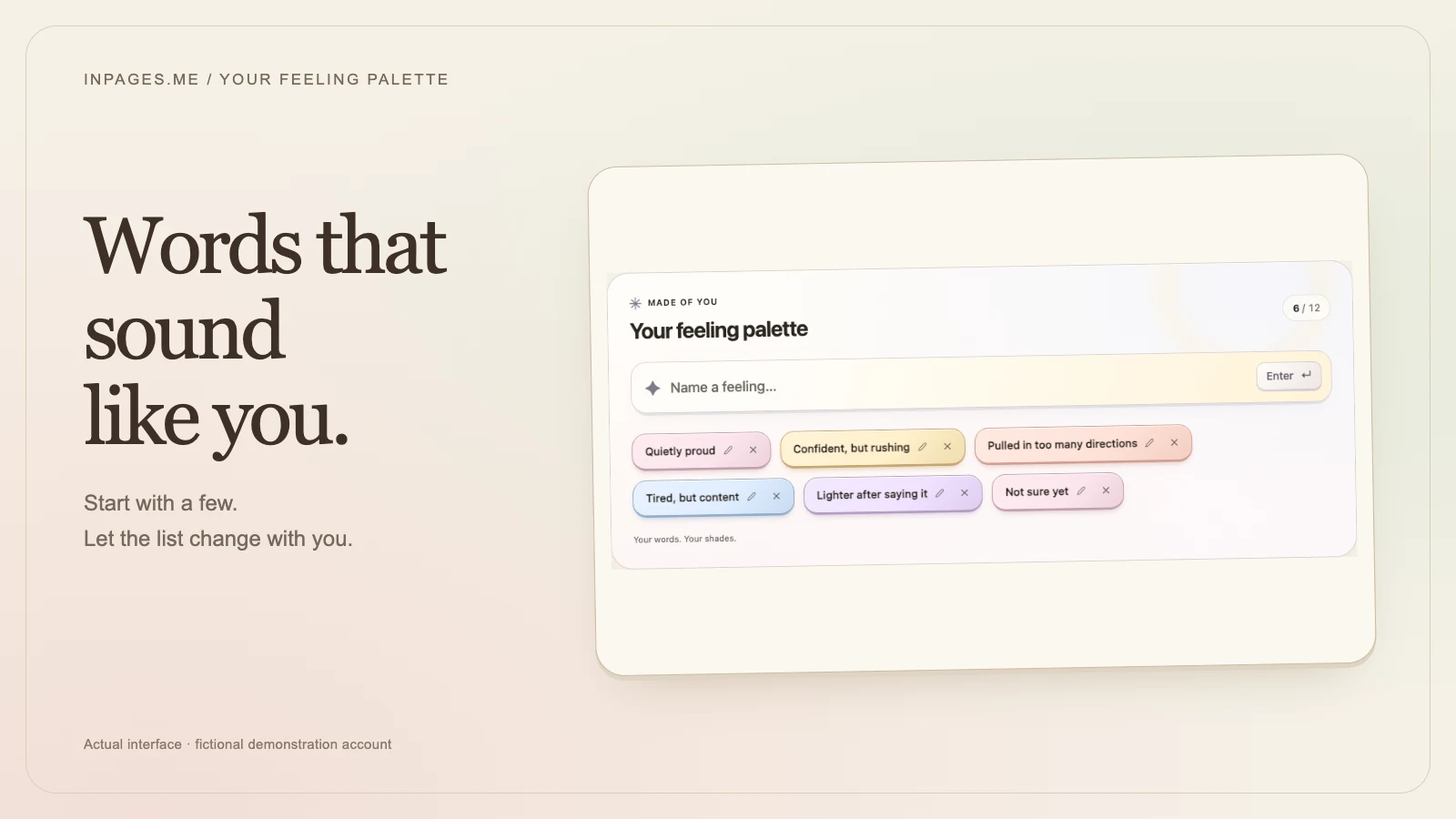
In Inpages.me, open Check-ins → Feelings. In Your feeling palette, type one of your chosen phrases and press Enter. Repeat for the few names you want nearby. The palette can hold up to 12 phrases.
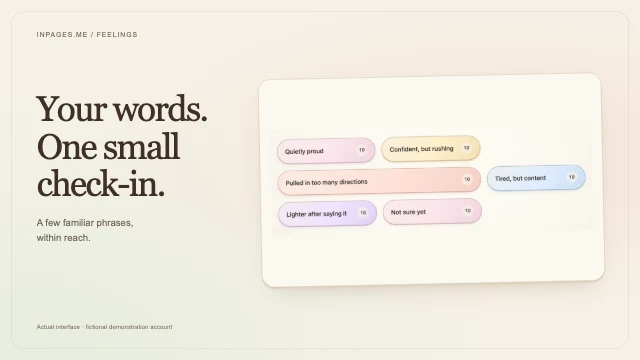
The floating Feelings button opens those phrases as quick recording buttons. You can rename or remove a phrase in the palette later; the words on older records stay as they were. The introduction to Feelings shows the recording gesture and where to find your saved entries.
Keep the list useful as your life changes
After using your list, notice which words you reach for and which you keep passing over. An unused phrase may still matter, or it may no longer fit. You can make that choice without treating the list as a collection to complete.
The timing can change too. For a few possible routines, read how often to log your feelings. Your list can be available without needing constant attention.
When you review your records, keep the wording in view alongside the numbers. The guide to reading a mood chart with curiosity can help you choose a question worth returning to.
Continue reading
Give your own words a small place in the day.
Choose a few phrases, then use them for a short record without having to write a full entry.