How to track your feelings without writing a journal entry
Track your feelings without writing a full journal entry. Choose a few familiar phrases, keep a quick record, and return later when you want more context.
To track your feelings without writing a journal entry, choose a few familiar words or phrases and record one when it fits the moment. Keep the time with it. You can return to the record later, with no paragraph to finish now.
This can fit the space between meetings, the end of a journey home, or the moment after a conversation when you know something has shifted. You do not have to explain the whole day before keeping one small part of it.
Decide what you want to remember
Begin with a question small enough to answer: What is present for me right now? A whole-day judgment can ask more than the moment can offer. “Relieved after finishing” may be more useful than trying to decide whether the day was good.
A quick record can hold a feeling and its time. A written entry can add the surrounding story when that is what you want. The comparison of mood trackers, mood journals, and daily check-ins helps you choose how much to keep.
Choose three phrases that sound like you
Make a short starting list. For example:
- Behind before I have begun.
- Quietly proud.
- Tired, but content.
You can use one word, a mixed feeling, or a phrase you would say to a friend. Choose labels you can recognise quickly. For a larger set of starting points, use the personal feelings list with 24 words and phrases.
If the right phrase has not arrived, “not sure yet” can be a starting point. The article on naming your emotions explores how words can help you notice a state without turning it into a judgment about yourself.
Keep the act of recording small
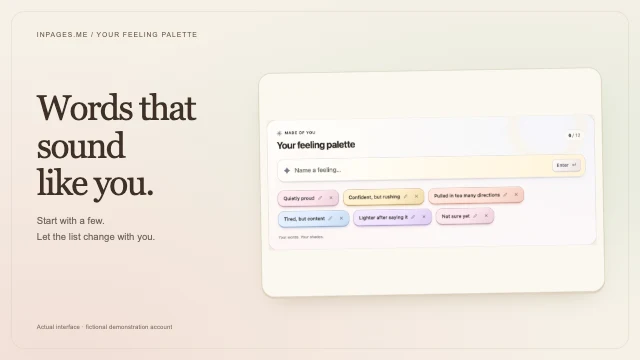
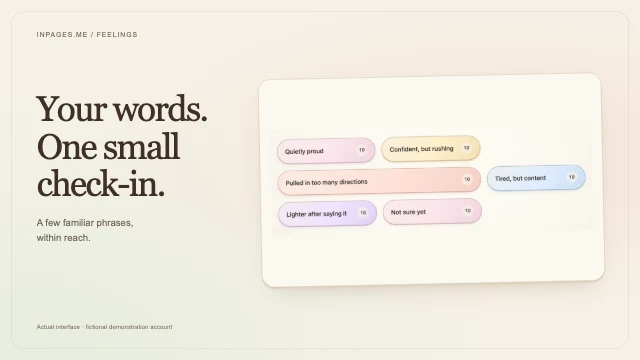
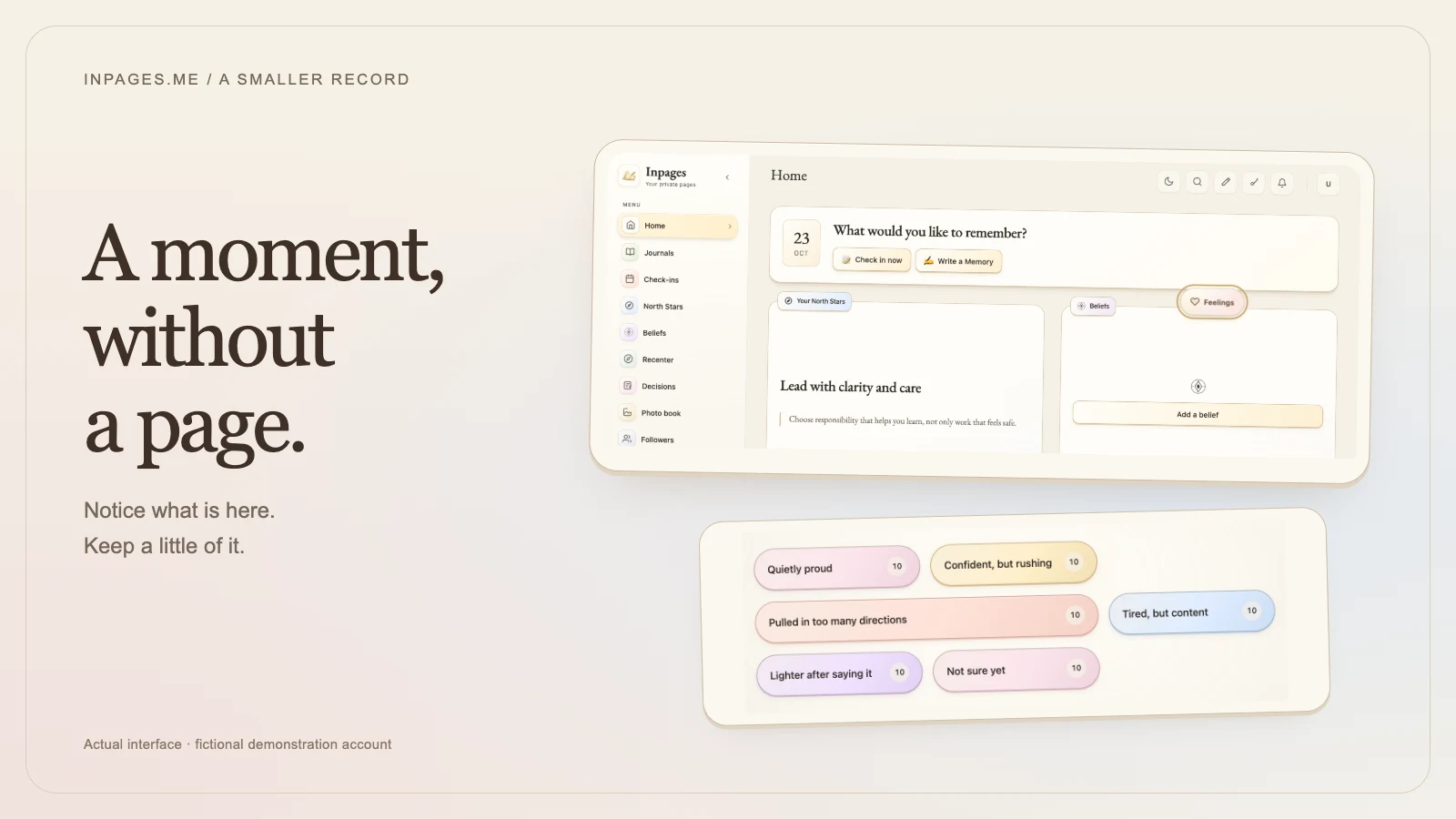
A note on paper or a simple list can work. In Inpages.me, Feelings keeps your saved phrases on buttons, available from a floating control as you move around the app.
Open it, choose a feeling, and release to save. A tap records 10 points; holding lets you choose a lower score. The record keeps the phrase, score, and time without asking you to complete a form.
Use the number as a mark you choose for that record. You can decide whether keeping a consistent personal meaning for the scale is useful. A shorter hold or a higher score is not an achievement to aim for.
Use a moment you already notice
You might check in after closing your laptop or after a conversation that stays with you. Pick one natural pause to try first. You can record again when you want to keep a different moment.
A missed check-in leaves a gap in the record. You can continue from the next moment you notice, without reconstructing a whole week or catching up on a writing task.
Inpages allows more than one record in a day. Each quick record has its own time, so an afternoon can have a different entry from the morning.
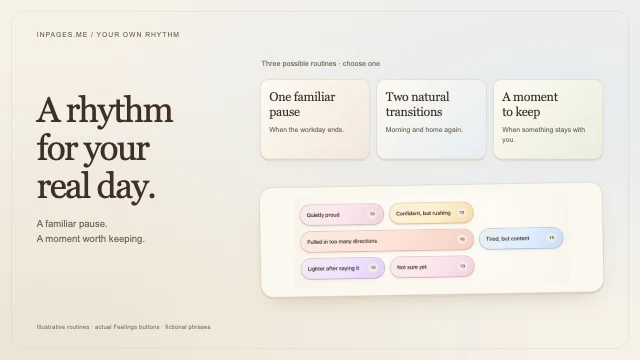
If you are deciding between a regular pause and recording when something changes, try these flexible schedules for logging your feelings. Choose by the moments you want to remember.
See what a small record can hold
Here is a fictional Tuesday:
- 8:10 a.m. — Behind before I have begun. A full inbox is waiting. There is no time to write about it.
- 2:30 p.m. — Quietly proud. A piece of work is finished. You keep that moment too.
- 8:15 p.m. — Tired, but content. The day ends with a different feeling from the one it began with.
These records leave several observations for a later visit. They do not explain the entire day. If one moment deserves more room, you can write a diary entry about it when you are ready.
Review what you recorded, with room for what you missed
After you have a few entries, read their phrases and times. Ask which moments you remembered to keep and which kinds of moments rarely made it into the record.
A frequently recorded phrase may describe a recurring feeling, a habit of checking in at particular times, or both. Your list gives you something to ask about. It cannot establish the cause on its own.
The guide to reading a mood chart without judging yourself offers a next step for reviewing patterns. If a record brings a longer story to mind, a Daily Check-in can keep the context alongside your quick observations.
Continue reading
Begin with a record small enough for the moment.
See the feeling palette, the recording gesture, and where to return to the words you saved.