How often should you log your feelings?
How often should you log your feelings? Try flexible check-in schedules for busy days, keep ordinary moments too, and choose a rhythm you can return to.
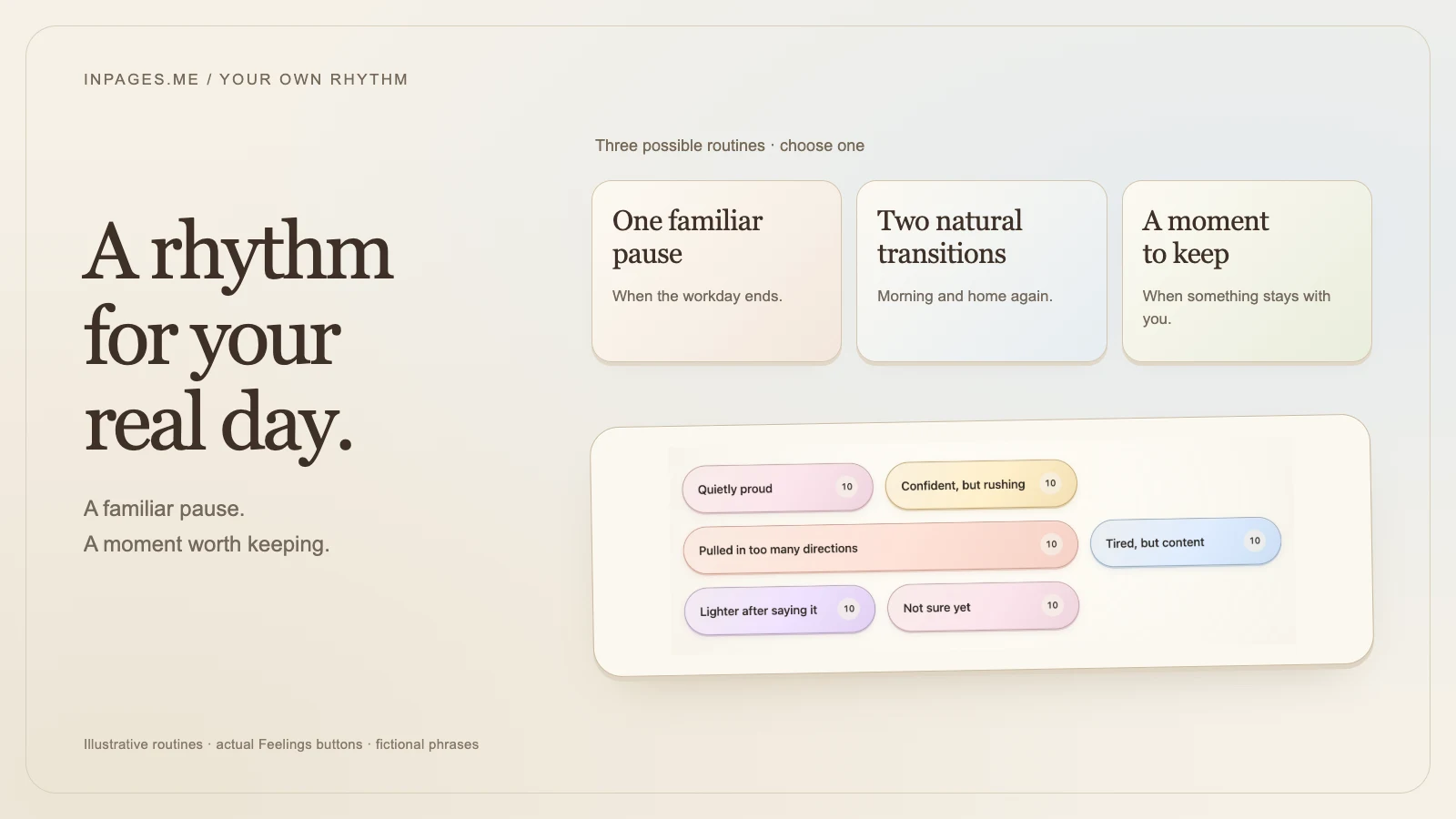
For a personal feeling journal, try one familiar pause in your day as a starting point. Add another when you want to keep a change you would otherwise miss. Choose the rhythm by what you want to remember and how much attention recording asks of you.
You might want a small note of how work ends, or a way to keep several different moments from the same day. Those are different jobs. A useful schedule makes room for yours without asking you to monitor yourself all day.
Begin with the question you want to return to
“How do I feel when I finish work?” gives you a particular moment to record. “What changes between morning and evening?” asks for more than one. “What stayed with me after that conversation?” may need only a single entry.
Choose one question before choosing a frequency. If writing is the part that makes the routine feel too large, begin with a feeling record without a journal entry. A phrase and its time can be enough.
Choose one of these three flexible rhythms
These are examples to adapt, rather than a tested schedule or a target to complete.
One familiar pause
Choose a moment that already belongs to your routine, such as putting your work away. Record what is present then: “drained after concentrating,” “quietly proud,” or your own phrase.
This keeps the starting point small. It also gives you a particular view of the day. An evening record describes that evening moment; it does not have to stand for everything that came before it.
Two natural transitions
If you want to notice different parts of a day, try a morning pause and the journey home, or the start and end of work. Use transitions that actually happen in your life.
You might save “eager, but scattered” before opening messages and “tired, but content” after closing your laptop. Two entries leave two observations. They do not explain what happened between them.
A moment you want to keep
Record after something you want to remember: a meeting, a decision, a difficult conversation, or an unexpected kindness. You can combine this with a familiar pause if that feels useful.
Include ordinary and comfortable moments when they matter too. If only difficult moments bring you to the buttons, the saved list will mostly describe those moments.
Keep the words easy to choose
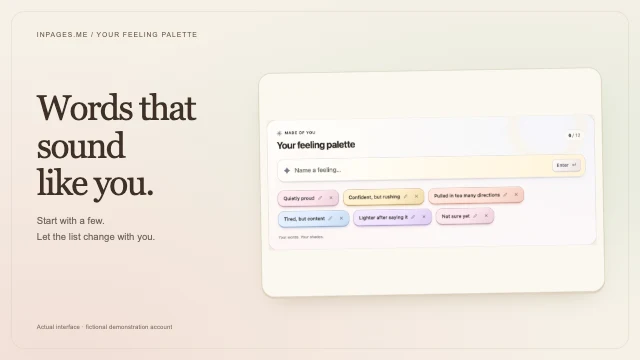
A large list can turn a brief pause into another decision. Begin with a few phrases you recognise. The personal feelings list offers examples you can shorten or rewrite.
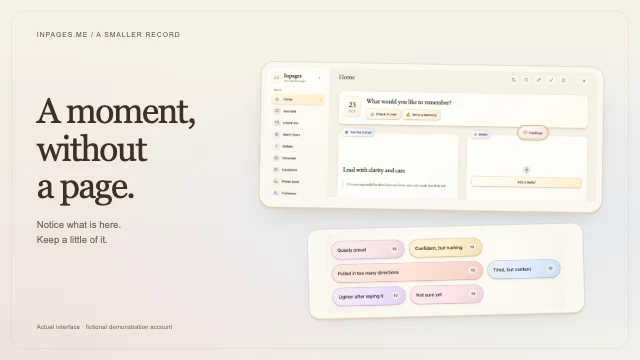
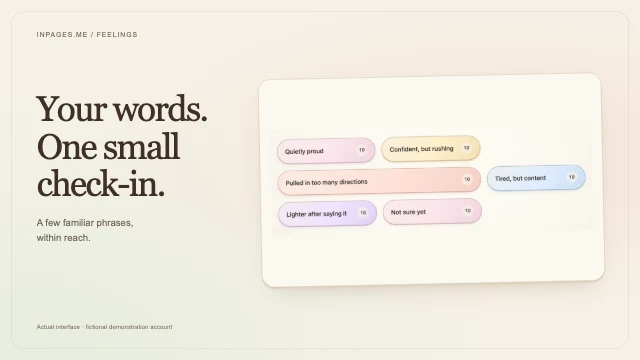
In Inpages.me, the floating Feelings button opens your saved phrases. Release a feeling button to save its words, selected score, and time. You can record again later in the day; no written note is required.
Let a real week have gaps
Imagine this fictional week, using the end of work as a familiar pause:
- Monday, 5:40 p.m.: “Pulled in too many directions.” One record before leaving the desk.
- Tuesday, 5:15 p.m.: “Quietly proud.” A finished task is worth keeping too.
- Wednesday: Nothing recorded. The gap stays a gap.
- Thursday, 1:20 p.m.: “Lighter after saying it.” A conversation prompts an extra record.
- Friday, 5:30 p.m.: “Tired, but content.” The familiar pause is available again.
You have a few moments to return to, without having to reconstruct every day. The additional Thursday entry serves the memory you wanted to keep; it does not create a new daily obligation.
Read the numbers alongside your routine
If you record twice as often next week, your entry count can rise even if your experience feels much the same. Inpages Feelings counts saved records. Total points also depend on how many entries you made and the scores you chose.
Before comparing two weeks, ask when you checked in, which moments you kept, and whether the routine changed. The guide to reading a mood chart without judging yourself helps put a summary beside its context.
A 2021 interview study with 22 mood-tracking app users found that some participants questioned how well their records represented moments they had not logged. The study explored people's experiences; it did not establish an ideal recording frequency. That distinction matters when choosing a personal routine.
Return to the current moment after a gap
If you miss your usual pause, continue when you next want to keep a feeling. A quick Feelings record saves the current moment. If you want to remember an earlier day, a fuller Daily Check-in gives you room to explain what you recall.
You can also make the next pause smaller: fewer phrases, a different time, or a record only when you have something you want to revisit. There is no need to fill a gap with an invented answer.
Change the rhythm when the purpose changes
After trying a routine, ask which records you are glad to have. If an evening entry misses a part of the day you care about, try a second pause. If recording keeps interrupting the day, make it less frequent or take a break.
The examples here are for personal reflection. If a clinician has asked you to keep a mood record as part of your care, follow the schedule and measures you agreed with them. For your own journal, keep the rhythm that leaves useful moments to return to and enough room to live the day around them.
Continue reading
Choose a pause that fits the day you have.
Keep a feeling in a few familiar words, then return to the story when you want more room.